Sunday, March 15, 2009

Where's the beach?

Entry 32:

For those of you who were following the international headlines, you will recall that there was a huge protest at the Bangkok International Airport for a couple of weeks in the beginning of December, 2008. As a result, we had to find a direct flight to the beaches that did not stop over in Bangkok. We flew to Phuket (pronounced Pooket) with the idea of taking a bus over to visit Krabi. We were ready to leave the cool weather of the north and enjoy some sunshine on the beach.

From the time we made it to Krabi, we realized that the south is much different than the north. While we were in Chiang Mai, we paid less than $10 for a room with A/C, satelite TV, and a private bathroom. Here in the south we paid more than $10 for a room with a mattress on the floor and a shared bath in the hallway. At least the Mr. Clean guesthouse lived up to its name. We also realized that Krabi, despite its fame, does not have a beach, and therefore could not keep us entertained for long.

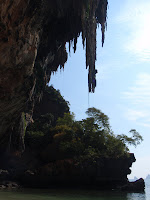
We were convinced both by our guidebook and other travelers we'd encountered that a beach called Hat Raley off the coast of Krabi was worth visiting. We took a longtail boat over and were enchanted by the scenery, which resembled Vietnam's Ha Long Bay...


...However, when we got off the boat and started walking around to inquire about guesthouses, we noticed that this miniscule island had very high-end resorts that were charging astronomical sums. All the backpackers seemed to be staying in a town nearby which we were warned to stay away from because of its pollution and noise. To add insult to injury, the beach was very small and roped off after only a few feet. That meant all the tourists paying top Baht were crammed into a tiny area or avoiding the beach altogether by going to their resort's pool. We were not impressed.
We gathered up our bags and hopped back into a longtail boat headed to Krabi. We decided to spend the night there rather than take a bus elsewhere. That night we found an internet cafe and booked a room at a resort in Phuket for four nights. Although we had been trying to avoid Phuket, we gave up trying to find the perfect beach and figured since so many tourists head there, Phuket must have some nice beaches. We considered working our way to the Gulf of Thailand to visit the islands of Ko Samui or Ko Phangan, but it was monsoon season and each ferry ride between the islands can be costly. We did some research on Phuket and avoided the most touristy of the beaches in favor of Hat Karen.

For more photos, visit: grossmintblog.shutterfly.com

Wednesday, March 11, 2009

Pai in the Sky

Entry 31:
Early on, we had read about the town of Pai in our guidebook. It was described as a hippy haven located in the Thai Highlands. Even though it seemed far off the beaten path, we were drawn to it like a moth to a flame. But getting there was quite an adventure. As with most minibus rides in S.E. Asia, the driver seemed content to exceed the speed limit whenever possible. This combined with the twisting narrow road contributed to extreme nausea. Somehow we made it to town without using the motion sickness bags.

If you'll recall, when we were in Vientienne we visited the tree house sauna. It was there we met Manny from Canada who told us about TaComePai, an organic farm whose friendly owner rents out rooms in authentic native hilltribe houses on stilts. Check out this funny You Tube video from a former guest. Unfortunately, it was too cold to go swimming and jump into the pond.

Since the farm is located about 5km outside of town, we needed to hitchhike to Pai. We thought no one would ever stop, but finally a pickup truck pulled over. The truck was packed with family members in the cab and all their luggage and camping supplies in the back. They told us to simply hop onto their belongings and off we went at a dizzying speed. We had to hold on to our hats.

When we got to town, we found something to eat and decided to rent a motor scooter. We flipped a coin and Sharon was designated as the driver. The only problem was, Sharon had never driven a scooter before. The guy renting it out took Sharon to a back street to practice. No pressure, though. Did we forget to mention that Thais drive on the opposite side of the road? Still, no pressure. OK - so the lesson was over and we were on our way.

Night was falling. The Mercury was following close behind, so we cruised back to Tacomepai. There we found the local farm hands and some Western volunteers gathered around a campfire eating veggie fare off plates carved out of bamboo. Later that night, the spirits began to flow and happy water was passed around. One local Thai girl named Kaew became intoxicated with happy water and let the rest of us know from a distance as we could hear her yelling all the way from our beds.

That night was rough on us, not so much because of Kaew, but because of the cold temperatures (mid-30s F) and the thin mattresses and blankets on the floor of our hut. The concept was cute, but cute didn't cut it from more than one night. We decided to find a more suitable option and bid farewell to our brethren in the morning.

After finding a new guesthouse, we hopped on the motor scooter and headed to a camping resort where we were told you could soak in the sulfur hotspring pools for only $0.50 per person. We sped off to find lunch and visit a few more scenic spots including a beautiful waterfall. That night we dined at Mama Falafel, a locally owned restaurant whose chef was taught the fine art of Israeli cuisine.

On our final day in Pai, we wanted to make good use of our motor scooter. We rode to the Chinese Village, and returned it after lunch at a riverside oasis called "The Sanctuary." Since we hadn't spent much time in town, we walked around for the rest of the day. On our walk, we bumped into Clark and Megan, two Kiwis we met previously in Lao. They were hanging out with two Brits they had met in Vietnam. The six of us spend the evening walking around town, sampling street food, and having beers at the Curry House known for its Reggae music.

Pai is truly unique as it attracts both Western and Asian hippies. It is not unusual to see its narrow streets packed with Thai tourists on long weekends, some of them even sporting dreadlocks. There are countless numbers of advertisements for yoga, meditation, and other new age practices. In addition, the town is known for adventure sports such as rafting, tubing, and rock climbing. It's a place we'd consider coming back to when the weather is warmer.

To view additional pictures, go to: grossmintblog.shutterfly.com

Tuesday, February 10, 2009

Thai Massage And So Much More

Entry 30:
As we approached the half way point of our journey, we had grown tired of hoisting up our backpacks every few days. We thought it would be nice to "chill out" for a little while and heard many nice stories about Chiang Mai, our next destination. That being said, upon our arrival in Chiang Mai, we immediately booked ourselves on a two-day trek into the mountains and through some ethnic villages. We departed the next morning.

Our trek began with a quick stop at an orchid/butterfly farm where we saw how orchids are harvested for sale in the local markets. The orchid is the unofficial national flower of Thailand and can be purchased for almost nothing.
After lunch, we began trekking through the mountains and made stops at a large cave and a local village. We were treated with tea served in bamboo cups. We liked the concept so much that we purchased a couple of those cups as souvenirs. We continued trekking for a few more hours before reaching our camp for the evening and celebrating with a cold shower. Everyone gathered around the campfire to stay warm and tell travel stories before going to bed.
That night may have been the coldest one we have ever endured. We slept in a wooden house on stilts. The room contained thin mattresses, each with its own mosquito next. We were given thin dirty blankets to cover up with, but they did not sustain the heat we needed. When you have a chance, make sure to ask Sharon about the kitty cat that decided to snuggled up with her. In the end, we were glad we'd signed up for only a one-night trek, while the majority of our fellow travellers signed up for two nights.

The next morning, we arrived at an elephant camp where each couple climbed up onto an elephant for a one-hour ride through the forest. The highlight of this particular walk was seeing the baby elephant, no more than six months old, follow alongside his parent's side. Our afternoon adventures were not over yet. We got to ride in a bamboo raft (see below) and then had a small taste of whitewater rafting (very fun!).

Our next stop was at the village of the Long Neck Karen. This is probably the most photographed hilltribe in all of Thailand and for good reason. Some of the women wear brass rings around their neck. There is a tale that explains the origin of this tradition. During the Golden Age, the Paduang tribal people were attacked by tigers. They were bitten at the neck and killed. The tribal leader was a sorceress who made sacrifices to wild spirits and declared that from then on, tribal girls and unmarried women must wear neck rings to avoid back luck. The rings consist of two sets. The first set sits on the wearer's shoulders. The second set is then set on top of the first set, but a pillow is inserted underneath it as a cushion under the chin. The two sets are then bolted together, although they can be separated for cleaning.

Traditionally, girls begin wearing the neck rings at age 5. Every three years, another three rings are added until the girl either turns 25 or gets married. The record for neck rings is 25 loops weighing just under 18 pounds. Today, neck rings are worn as a sign of beauty. More recently, wrist and leg rings have also become popular. Despite the rings worn and the name they've been given, the Paduan tribal people do not really have longer necks than other people. In fact, the rings' heavy weight pushes down on their chest making the neck look elongated.


While at this village, we also saw a woman with a big ear lobe. To obtain this effect, women place big loops inside the ear lobe in the hope they will have a long life.


Our final stop on the trip was at a nearby river where we hiked upstream for about 10 minutes until we arrived at a small pool with a waterfall. Although the water was cold, we jumped in anyways to refresh ourselves from a long couple of days of adventure.
After all the fun we had, we were back in town and ready to explore. From the very start, we knew we wanted to learn Thai cooking. We found a nice cooking school and signed up for the following day. We arrived first thing in the morning, were taken to the local market and instructed there about the ingredients we would later use. At the school, we were given a choice of seven dishes to make. Each person could select different dishes, but you could taste from everybody's dish afterwards.
The first step was to chop up everything. We then walked over the the cooking station where each of us was given a wok, some condiments, and our chopped ingredients, and before you knew it - viola - we had made papaya salad, tom yum soup, pad thai, sweet and sour tofu and vegetables, red and green curry, and sticky rice with mango. It was fun not only to make the food, but we then got to hang out and eat it all. We recommend this experience to those of you going to Thailand!

Chiang Mai is also well-known for its massage schools. Many foreigners come here to learn how to administer Thai massage. After shopping around for a reputable school, we decided on a five-day course at Nerve-Touch Massage School. Each day, we'd wake up early, arrive at our class with our book in hand, and learn about twenty new steps of the school's techniques. After breaking for lunch, we'd spend the rest of the day practicing on each other.


On the fourth day, we learned how to prepare an herbal compress, which can be used to enhance the effects of the massage by applying heat and herbal properties to the body's most problematic areas. We're now ready for business!
This is our teacher's demonstration:
Many people love Chiang Mai because it is a spiritual city filled with dozens of temples. At several of the temples, there are monks who encourage people to stop by to speak to them about all matters. One day, we spent a good two hours at the Chedi Luang temple speaking with two monks to learn more about their lifestyle and responsibilities. They were equally intrigued by us.
Despite its population of more than one million people, Chiang Mai is actually quite an interesting place for tourists. There are dozens of international restaurants, guest houses, and interesting shops of all kinds. Each evening there is a night market which caters to tourists. Every weekend there are special markets that tend to attract mostly locals. In addition, Chiang Mai is relatively inexpensive compared to the rest of Thailand. It was a memorable visit.
For more photos, please go to: grossmintblog.shutterfly.com

Sunday, February 8, 2009

Golden Triangle


Entry 29:
Chiang Rai is a cute little town with an exceptional night market, food stalls, and simply an authentic feel to the place. We imagine it is similar to how Chiang Mai was once upon a time before it became so commercialized. Although we had just arrived, the next morning we got on a bus going back towards the border as we wanted to visit the Golden Triangle. It is the point where the three countries -- Thailand, Laos, and Burma -- meet and where not so long ago there was a strong opium trade.

The bus dropped us off in Chang Saen and from there we had to take a minibus to the Golden Triangle. Before leaving Chang Saen, we confirmed the times of the minibus' return as we had to catch the bus back to Chiang Rai. We were assured the minibus comes around every hour until 4pm. This was important to us as some Australian tourists we came across in Laos told us about tourists being scammed by local taxi drivers who claimed there were no more minibuses.

The area of the Golden Triangle boasts two opium museums. The first is a small homey museum that speaks partially about opium and partially about the hilltribes. The second is the one usually avoided by backpackers for its heavy duty admission price (around $10 per person). We started off with the first.
The history of opium is quite interesting. We found out that although the original discovery sight of opium remains unknown, it was used as early as 1000 BC by the Greeks, Romans, Persians, and Egyptians. Its name means "fruit juice" and this plant was used for its medicinal qualities in the Mediterranean region to treat a variety of diseases.
*
Around approximately 356-323 BC, Alexander the Great brought opium to both China and India. Years later, England monopolized the opium trade in China (but we'll get to that later). At the end of the 19th century and beginning of the 20th century, some hill tribes who moved from China to the three countries of the Golden Triangle brought opium with them. The rest is history.

The second museum is a multimedia extravaganza complete with flat panel televisions, surround sound, a brief film shown in a fancy auditorium, and other audiovisual displays. It was financed by the Queen of Thailand in a public effort to demonstrate the country's dedication to ridding itself of its troubled past with international drug trade.
*
Here's a bit of history that starts with opium and goes on a bit of a tangent:
China's silk and spices were in high demand in the West, so Britain began exchanging opium for these goods. However, as more and more Chinese became addicted to the drug, the Emperor of China tried to ban it from the country. This brought on the Opium Wars.
*
England was not about to give in, especially as Anna, the Duchess of Bedford, made afternoon tea fashionable. As tea drinking became a more popular custom, England was more invested in increasing its import of tea. However, in the early 1800s it took over a year to ship tea to Britain from China. Thus, the British established the East India Company, monopolized the trade on tea, and began using faster vessels to speed the delivery along. Not only was the beverage popular, but so were the utensils it was served in. That started the import of fine china to England. Additionally, as the Duchess enjoyed drinking her tea with both milk and sugar, spoons were necessary. Consequently, fine silverware became part of tea culture. This also increased the demand for sugar from the New World and put increased importance on the Triangle trade (so called for its three components: slaves, sugar, and rum) in North America. The museum has a fancy website. Check it out for more information.
*
Even though we had been told the minibus would be running until 4pm, when we returned to the pickup spot, all the taxi and motorcycle drivers told us the minibus was done for the day. We figured they were just trying to earn out business. There were supposed to be at least two more minibuses that day, so we waited around. When neither one showed up, we decided to negotiate with two motorcycle drivers to take us back to Chang Saen or risk missing the last bus to Chiang Rai. Within 20 seconds of getting on the motorbikes, Sharon spotted the minibus. We quickly jumped off and ran to it. We were relieved when we made our bus to Chiang Rai on time.
*
One of the highlights of Chiang Rai is its lively and exciting night market. Dozens of vendors set up their stalls as well as a variety of food sellers with everything from pad thai to sushi to "mixed insects." We guess you really have to be in Thailand to appreciate the latter. We strolled through the aisles of handicrafts and picked up all sorts of goodies. Marc is especially eager to attend a formal event so he can wear his Thai silk tie covered with a zillion miniature elephants.
For more photos, go to our shutterfly account: grossmintblog.shutterfly.com

Sunday, February 1, 2009

Farewell to Laos

Entry 28:

When travelling through S.E. Asia, it is always wise to expect the unexpected and not be too discouraged when things don't go as planned. Many cities in this part of the world do not have bus stations in the center of town. Therefore, when you purchase a bus ticket, it often includes a pickup at your hotel. Sometimes this process can be painless, but at other times extremely painful. Even though we were picked up on time, it took nearly 90 minutes just to collect the remaining passengers and finally depart Luang Prabang. Add to this the extremely loud Laotian pop music blaring through the minivan speakers. Sometimes you just have to scratch your head and remind yourself - You're in Asia.

At this point in our trip, we were faced with the decision to take the slow boat up the Mekong River to the Thai border or visit a few more towns in Northern Laos. We chose the latter as we still had several days left on our visa and had enjoyed our stay thus far and were hungry for more. Our next stop was a small town in the mountains callled Nong Kiaew. The views were spectacular, but otherwise, the town had little to offer.

We walked about one hour outside of town to see Pathok Cave. During Lao's troubled past, this site was transformed into a hidden village complete with a hospital.


In the guidebook, we had read about a national park close to the town of Luang Nam Tha that offered visitors a wide variety of wildlife and tropical vegetation. This sounded great to us, and we headed there the following day. Unfortunately, there were no direct buses and we were forced to spend the night in Udom Xai, a small dusty town that sees many Chinese businessmen passing through. The book describes it as an ideal stopping point for truckers and not much more than that. For once, the book was right on. We did manage to find a sauna and spent the afternoon sweating with the locals.

When we finally arrived in Luang Nam Tha, we discovered that it is not possible to enter the national park without a guide. We shopped around for a guided trek, but realized the terrain would be difficult to climb and the prices were just as steep. We took the time to catch up on some internet and, of course, found time for one last sauna. There, we met a young local village woman who told us about her experience studying in the country's capital. Her yearly rental for an apartment in Vientienne cost her the equivalent of about $200, a steep sum for Laotians, which somehow she managed to pay.

It seemed as if our time in Laos was nearing its conclusion so we boarded a minibus to Huay Xai to cross the border into Thailand. We grabbed some pad thai to go as we had no idea what to expect on the other side of the border. We changed our remaining Kip into Thai Bat, passed through immigration, and jumped into a longtail boat for the 5-minute ride across the river. Lao will remain one of our favorite places to visit in S.E. Asia (if not for its disfunctional ATMs then for its charm, beauty, and down-to-earth nature).

You can see more of our photos at: grossmintblog.shutterfly.com

Saturday, January 31, 2009

Elephants On Parade

Entry 27:

One of Lao's most famous eco-tourism adventures is called a Mahoot. It is a chance to get really close to one of mother nature's largest animals, the elephant. We signed up for a two-day, one-night mahoot in which we would ride the elephants, learn their commands, and bathe them.

On day one, they picked us up from our hotel and we drove for about a half hour outside the city to the elephant camp. Once there, we found our house on stilts which would be our "hotel room" for the night. On the beds were our blue denim uniforms for riding.


These uniforms help the elephants identify their masters. We wasted no time and walked over to the elephant encampment where they keep and feed the elephants. We introduced ourselves to a few friendly faces:

Our first experience riding on the elephants was on a wooden seat on the elephant's back. Each of us had our own elephant and guide with us. We learned that the elephants eat more than 200 pounds of food every day and spend about 18-20 hours eating. It was amazing to see the elephants pick up whole pineapples and stick them in their mouths to bite off the fruit and toss the green stems. They also can devour entire foot-long sections of sugarcane. Their bodies are covered with thick prickly black hair, but the skin behind their big flapping ears is nice and smooth. The elephants also have long eyelashes and they are constantly batting their eyes. Each of the elephants at this camp wears a bamboo bell around their neck, which produces a rhythmic song as they trod through the forest. Most of the elephants that tourists ride in S.E. Asia are females due to their more calm demeanor.

The next step was to get down and dirty. We rode directly on the neck of the elephant. At this point, we used the commands we learned in Lao to direct the animal in whichever way we needed. "Pai Pai" meant "go straight." "Pai Sai" was to let the elephant know he/she should walk left, while "Pai Qua" was to the right. After all this training, the elephants needed to cool down, so we rode to the river and helped give them a bath. The guides were all too thoughtful. They appeared at first to be eagerly splashing the elephants, but were in reality trying their hardest to get us all wet. Despite this, we had a great time as evidenced by this video:


To cap off the day, our guide took us down to the edge of a river where we climbed aboard a long-tail boat and went upstream a couple of miles. From there we floated downstream atop innertubes and watched the world go by.

After a long day of riding elephants and tubing down the river, it was time for a refreshing cold shower in our outdoor bathroom in the back of our wooden house. While it was enclosed to shut peeping eyes out, we could shower under the clear blue skies. We left our denims to dry on the porch and went off to dine alfresco on some excellent vegetarian curry, vegetables, and rice. In the mix of vegetables, we found an elephant-shaped mushroom, which seemed pleasantly appropriate at the time.


We then returned to our cabin for some well-deserved sleep, knowing we'd be up early to once again bathe the elephants.

The next morning, other than it being early and very cold, we had to dress back in our uniforms. However, as it was cold the day before, they had not dried. So there we were at 6:30am in our wet denim suits going to ride the elephants into the river for their morning bath. The sun eventually came up and we dried off and warmed up.

Finally, it was time to say goodbye to our new friends and head off to see one of Lao's many waterfalls. We returned to the longtail boat and sped up the river to swim under the falls. In contrast to the previous falls we visited, these falls were much smaller, but you could get right underneath them for a nice head massage. Our guide was an excellent photographer for us while we got wet and helped us document our adventure.


Once back in town, we decided to return to our favorite sauna. We steamed for a couple of hours and then got pampered further with an oil massage. To cap off the night, we ate dinner at a Lao BBQ restaurant that served "falang-sized" portions. Falang is a term used by the locals to describe any foreigner. It comes from the Lao word for French people. Thus, our extra-large portion was more than you would normally find in a local Laotian restaurant. Despite our waiter's insistence that we get a portion big enough for 2, we ordered the dish for one. The waiter brought out a small habachi-like BBQ to the table where we cooked our food before our very eyes.


To see more of our wonderful photos, please go to: grossmintblog.shutterfly.com

Friday, January 16, 2009

City of Monks

Entry 26:

In order not to repeat our bus fiasco with the Frenchies, we decided to go directly to the bus station in the morning. We boarded the first minibus and got seats right up in the front. Seven hours later, our bumpy butts arrived in one of the most magical places we had yet to see.
Throughout our trip, we had heard many amazing stories about Luang Prabang. People described it as a very special place and we were pleased to finally be there. One thing we did not expect was the extraordinarily high prices for guest houses. We walked the streets for a couple of hours making inquiries and were blown away when guest house owners quoted us prices of $30 or more. Finally, after covering almost the entire city, we found something in our price range.

The city of Luang Prabang provides many excellent opportunities for tourists to spend their money. Whether it's booking a tour, a guest house, restaurants, or shopping at the beautiful night market, there are endless ways to part with your kip. Unfortunately, the city only has one ATM machine, which was broken during our first several days there. As a result, we had to live off of our remaining $20 worth of kip. Having no other choice, we ate dinner at the night market. We found a lovely booth that served all vegetarian food for the equivalent of 60 cents. It was a plateful of delicious vegetables that had us coming back even after we managed to take money out of the ATM.


For the next several days, we wandered the streets viewing the endless number of Buddhist temples and shrines, as well as the Royal Palace and the National Museum. We even woke up before sunrise to watch the endless parade of saffron-clad monks walking the streets barefoot with metal bowls in hand. They came to collect generous food donations (i.e., sticky rice) from local citizens. This was quite a site to see:


One activity that most foreign visitors probably fail to discover is the Laotian affinity for steam rooms. During our urban journey, we stumbled upon the Happy Herbal Steam Spa. For the equivalent of $1 per person, we were able to wrap ourselves in piece of cloth and enter a small wooden room with a fire burning underneath. The room filled with steam as well as a variety of different Lao people. Upon exiting into the chilly air, we were greeted by our smiling hostess who provided us with hot cups of herbal tea. We continued in and out of the steam room for the next two hours, each time with a new cup of tea. In other words, it's an all-you-can-steam-and-tea for a buck.
Luang Prabang has two noteworthy waterfalls nearby. We had the privilege of visiting them both. The first one, Kouang Si, is about a one-hour drive from the city. When you arrive, there is a small sanctuary sheltering several endangered bears. From there, there are trails on either side of the river leading up to several waterfalls and swimming areas. Although the water was really cold, it was a great way to cool down in the hot afternoon sun.


When we returned from the waterfall, we discovered that the ATM was finally working and providing money to the hordes of tourists waiting for its bounty. Happy days were here again. We took our fists fulls of kip and walked over to the offices of All Lao Excursions. We signed up for a 2-day elephant extravaganza called a mahout. According to the brochure, we would spend the next two days riding elephants, learning the elephant commands, bathing the elephants, and anything else associated with these wonderous creatures. We were giddy with anticipation, but you'll have to read the next blog entry to hear all about it.
For more photos, go to: grossmintblog.shutterfly.com